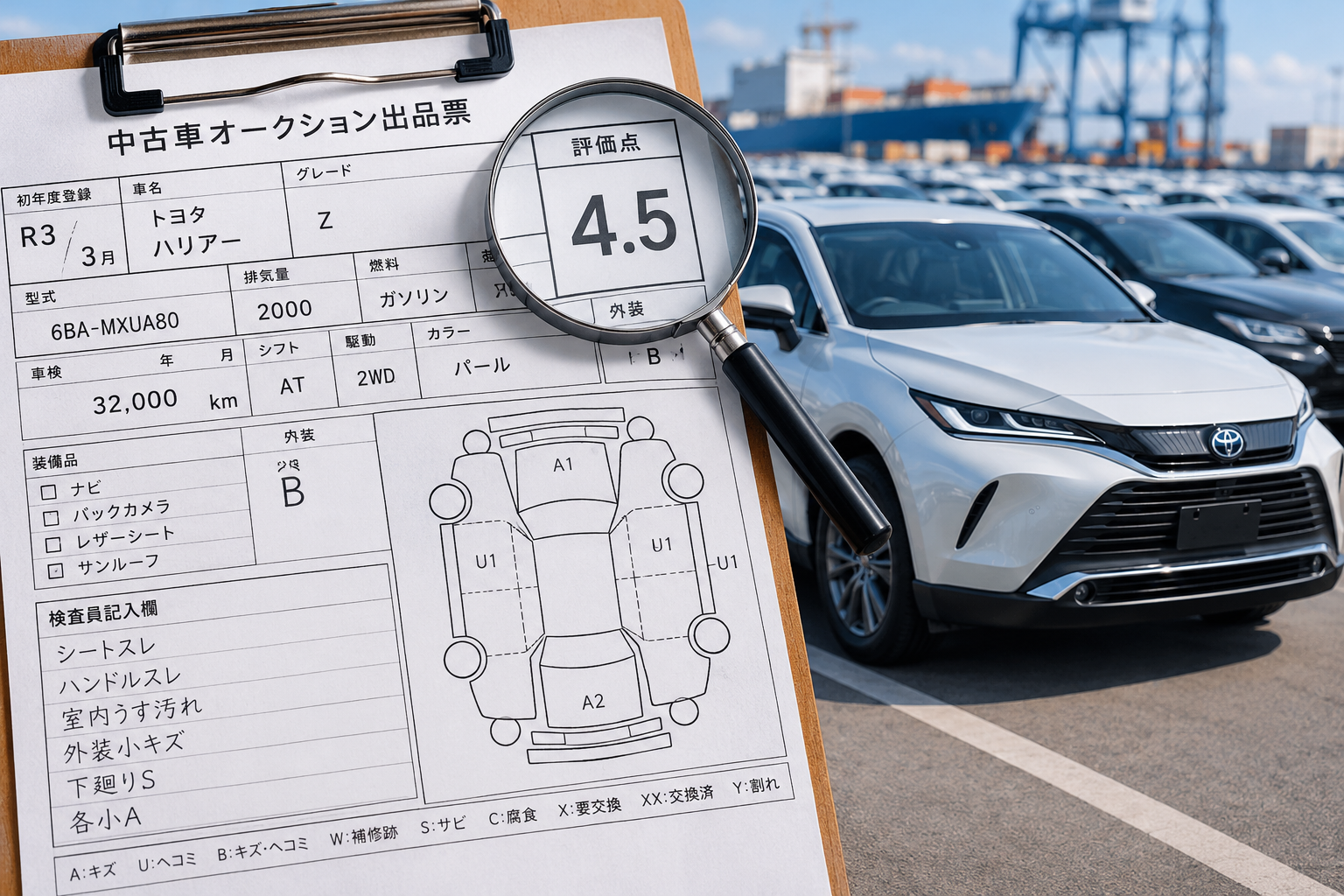
A Japanese used car can look excellent in photographs and still have scratches, repaired panels, interior wear or other issues that are not immediately obvious. For overseas buyers, understanding the auction sheet is one way to look beyond the pictures before deciding whether a vehicle is worth considering.
Japanese vehicle auctions use inspection sheets to record vehicle details, condition grades, damage locations and the inspector’s observations. The information can help buyers compare vehicles, but the grading system is not identical across every auction house. A grade should therefore be read alongside the condition diagram, written comments, mileage and available photographs.
What Is a Japanese Car Auction Sheet?
A Japanese car auction sheet is a vehicle inspection report completed for a car offered at auction. It generally includes identification details, mileage, overall condition grade, interior or exterior assessments, equipment information and an illustrated diagram showing visible defects.
Many sheets are written in Japanese and use abbreviated descriptions. Buyers who cannot read Japanese may need a reliable translation to understand the inspector’s comments correctly.
A typical auction sheet may contain:
- Vehicle details: Make, model, model code, registration year and chassis number.
- Mileage: The odometer reading recorded during inspection, along with any relevant warning or discrepancy.
- Overall auction grade: A summary assessment of the vehicle’s condition under that auction house’s grading rules.
- Interior and exterior grades: Separate assessments where provided.
- Condition diagram: A vehicle outline marked with the location of scratches, dents, rust, repairs or other defects.
- Inspector’s remarks: Written observations about the vehicle’s condition, equipment, repairs or potential concerns.
The exact layout and terminology depend on the auction house. Buyers should use the original sheet and its applicable grading legend rather than assuming every auction follows precisely the same format.
Japanese Car Auction Grades: What Do the Numbers Mean?
The overall grade gives buyers an initial indication of a vehicle’s condition. It is useful for narrowing down options, but it does not tell the complete story.
The following table describes common interpretations of grades used at Japanese vehicle auctions. These are general guidelines, not universal guarantees.
| Auction grade | General interpretation | What buyers should check |
|---|---|---|
| S | Nearly new or exceptionally well-preserved vehicle under the relevant auction’s criteria | Registration details, mileage and inspection notes |
| 6 | Exceptional condition, often associated with newer vehicles | Eligibility criteria, age, mileage and any recorded defects |
| 5 | Excellent overall condition with limited signs of use | Condition diagram and inspector comments |
| 4.5 | Very good condition, generally with relatively minor wear | Scratches, dents, repairs and mechanical remarks |
| 4 | Good used condition, with some wear or minor defects possible | Bodywork, interior, mileage and maintenance needs |
| 3.5 | Average used condition, with more noticeable wear or defects | Repair estimates and the number and location of damage marks |
| 3 | Below-average condition or more substantial visible wear | Bodywork, corrosion, repairs and any mechanical concerns |
| 2 or 1 | Poor condition, significant deterioration, modifications or other issues depending on the auction | Full inspection details and suitability for the intended use |
| R / RA | A repair-history classification under the relevant auction’s rules | Nature of the repair, affected areas and available supporting information |
| 0, *** or another special mark | May indicate an ungraded, damaged or specially classified vehicle, depending on the auction | The exact meaning stated by that auction house |
Not every auction house uses every grade, and definitions can differ. In particular, R and RA should not automatically be treated as identical classifications across all auctions.
Is a Grade 4.5 car better than a Grade 4 car?
A grade 4.5 generally indicates a higher overall condition assessment than grade 4 under the same auction’s grading system. However, the difference does not automatically make the grade 4.5 vehicle the better purchase.
For example, a grade 4.5 vehicle may have a higher price, while a grade 4 vehicle may offer suitable condition for its age and intended use. The lower-graded vehicle could be worth considering if its defects are minor and its documented condition meets the buyer’s requirements.
Compare both vehicles using:
- The location and severity of bodywork marks.
- Interior condition and equipment.
- Mileage and vehicle age.
- Inspector remarks and repair history.
- Photographs and any additional inspection information.
- Total purchase and import costs.
The practical rule: Use the grade to shortlist vehicles, then use the rest of the inspection information to compare them.
Interior and Exterior Grades: What Do A, B, C, D and E Mean?
Some Japanese auction sheets provide separate letter grades for the interior and exterior. These should not be confused with the overall numerical grade.
A common interior grading pattern is:
| Letter grade | General interpretation |
|---|---|
| A | Very clean interior with minimal visible wear |
| B | Good condition with some light wear |
| C | Average condition, potentially including stains or noticeable use |
| D | Heavier wear, damage, tears or staining |
| E | Poor interior condition or substantial wear |
The precise descriptions vary by auction house. Some sheets also use separate exterior grades or different letter systems, so check the labels on the actual document.
What should you look for?
A vehicle with a high overall grade may still have an interior that does not meet your expectations. Check the cabin for:
- Seat damage, tears and stains.
- Dashboard or door-trim damage.
- Worn steering wheel and controls.
- Unpleasant odours or signs of smoke exposure, where recorded.
- Damaged roof lining or carpets.
- Missing equipment or accessories.
For the exterior, look for paint damage, dents, scratches, corrosion and signs of previous repairs. Confirm that the photographs match the condition described in the sheet.
Japanese Auction Sheet Symbols: How to Read the Damage Map
The condition diagram is one of the most useful parts of an auction sheet. It marks the approximate locations of defects on a vehicle outline.
Many auction sheets use letter-and-number combinations. The letters often describe the type of defect, while the numbers indicate its size or severity. However, the exact meaning can vary, so always check the auction house’s legend.
Commonly encountered symbols include:
| Symbol | Common interpretation | What to check |
|---|---|---|
| A | Scratch | Length, visibility and affected panel |
| U | Dent | Size, depth and location |
| B | Dent with a scratch or combined bodywork defect on some sheets | The legend and the actual damage |
| W | Wavy surface or evidence of bodywork or repair on some sheets | Whether the panel has been repaired or repainted |
| S | Rust | Extent and location, especially on vulnerable body areas |
| C | Corrosion | Severity and whether it affects important structural areas |
| X | A part or panel that may require replacement on some sheets | Which component is affected |
| XX | A part or panel already replaced on some sheets | Why it was replaced and whether structural areas were involved |
| Y | Hole, crack or another defect on some sheets | The applicable legend and inspector’s notes |
| G | Glass-related damage on some sheets | Whether the windscreen or another glass component needs attention |
These descriptions are a starting point, not a universal decoding system. Even a familiar letter may be used differently across forms, so do not rely on a symbol list without checking the relevant auction house’s documentation.
What do A1, U2 and W3 mean?
Where an auction uses numbered damage symbols, the number commonly indicates the size or severity of the defect. For example, A1 may represent a smaller scratch than A3, while U2 may indicate a more substantial dent than U1.
The numbering convention is not universal. Check the particular auction’s legend before estimating the repair needed.
Why the location of a defect matters
Two vehicles may have similar numbers of damage marks but very different implications.
A small scratch on a bumper is generally a different concern from corrosion or repair evidence around a pillar, sill, floor or other important body area. A replaced bolt-on panel is also not automatically the same thing as structural accident repair.
When reviewing the diagram, ask:
- Which panel or area is marked?
- Is the defect cosmetic, or could it affect a structural area?
- Does the inspector mention previous repairs or additional concerns?
- Do the photographs support the written description?
- Is further inspection needed before making a purchase decision?
Do not decide that a vehicle has structural damage based on one symbol alone. Confirm the meaning and location with a qualified inspector or the exporter.
How to Read Mileage and Inspector Remarks
Mileage is an important part of a vehicle’s history, but it should not be interpreted in isolation.
Compare the recorded mileage with the vehicle’s age, available service records and other supporting information. If the sheet contains an odometer warning, an unexplained discrepancy or a notation you cannot interpret, ask for clarification before proceeding.
A low mileage figure does not automatically mean that a vehicle is in excellent condition. Maintenance history, usage, storage, corrosion and previous repairs can also affect its condition.
Pay close attention to handwritten notes
The inspector’s remarks may contain information that is not obvious from the headline grade or damage map. Depending on the vehicle and auction house, notes may refer to:
- Engine or transmission concerns.
- Oil or fluid leaks.
- Unusual noise.
- Bodywork or repainting.
- Rust or corrosion.
- Missing parts or equipment.
- Electrical or other functional issues.
- Mileage-related warnings.
These are examples of possible inspection remarks, not a claim that every sheet records all these items. A standard auction inspection is not necessarily a comprehensive mechanical examination.
If the remarks are handwritten in Japanese, obtain a full translation rather than relying only on a translated summary or the overall grade.
What Does R or RA Mean on a Japanese Auction Sheet?
R and RA are commonly associated with vehicles that have a repair history, but their exact definitions and thresholds depend on the auction house.
A repair-history classification should prompt further investigation, not an automatic decision to buy or reject the vehicle.
Before considering an R- or RA-graded car, ask:
- What type of damage or repair was recorded?
- Which body areas were affected?
- Was any structural component involved?
- Are the original inspection sheet and photographs available?
- Has the repair been assessed by a qualified professional?
- Does the vehicle meet the requirements of the destination country?
A vehicle’s repair history can have implications for safety, resale value, insurance and import eligibility. These factors should be checked against the specific vehicle and destination market.
Also remember that a good numerical grade does not replace a repair-history check. Read the overall grade, condition map and inspector’s remarks together.
Which Japanese Auction Grade Should You Choose?
There is no single best grade for every buyer. The right choice depends on the vehicle’s price, age, intended use, condition and the costs involved in importing it.
For buyers prioritising condition
Vehicles graded 4.5 or 5 may be worth comparing if the budget allows. Still, review the inspection sheet and supporting evidence rather than assuming a high grade means the vehicle is flawless.
For buyers seeking a practical used car
Grade 4 vehicles may be suitable candidates when the recorded defects are acceptable, the vehicle’s history is satisfactory and the price reflects its condition.
For buyers considering a lower-priced vehicle
Grade 3.5 vehicles may be worth examining when the buyer understands the recorded wear and has accounted for potential repair costs. A lower price is not necessarily a saving if the repairs are extensive.
For buyers considering R or RA vehicles
Proceed only after understanding the repair history, checking the affected areas and assessing the vehicle’s suitability for the destination market. These vehicles may not be appropriate for every buyer or use case.
Instead of selecting a vehicle based on grade alone, compare its complete condition, documentation and estimated landed cost.
Checklist Before Buying a Japanese Auction Vehicle
Before committing to a vehicle, work through this checklist.
- Obtain the original auction sheet. Ask for the complete document rather than a cropped image or a summary.
- Verify the vehicle identity. Match the chassis number and other identifying details against the available documentation.
- Confirm the overall grade. Check the auction house’s grading criteria.
- Review interior and exterior grades. Identify any condition issues that matter to you.
- Read the entire damage map. Note the location and severity of each marked defect.
- Translate all inspector remarks. Clarify handwritten comments and unfamiliar abbreviations.
- Check the mileage information. Investigate any warning or discrepancy.
- Request supporting photographs. Compare visible condition with the sheet.
- Ask about repairs and mechanical checks. Understand what has and has not been inspected.
- Calculate the total cost. Include the vehicle price, applicable auction and export charges, shipping, insurance, destination taxes, duties, compliance costs and local registration.
- Check import requirements. Confirm that the vehicle meets the current rules of your destination country before purchasing.
An auction sheet is a valuable assessment document, but it should not be treated as a warranty or proof that every mechanical component has been tested.
What Documents Should You Request From a Japanese Car Exporter?
The exact documents depend on the vehicle, transaction and destination country. Before proceeding, ask the exporter which records are available and which will be supplied with the vehicle.
Depending on the transaction, useful documents may include:
- The original auction sheet and its translation.
- Vehicle identification and chassis details.
- Available auction photographs.
- Export and shipping documentation.
- Invoice and payment records.
- Available service or maintenance records.
- Additional inspection reports, if commissioned.
Clarify what each document proves. For example, an auction sheet records an inspector’s assessment; it does not by itself establish that a vehicle meets every import, registration or roadworthiness requirement in the destination country.
Find a Japanese Used Car That Meets Your Requirements
Understanding auction grades can help you compare vehicles more carefully, ask better questions and avoid relying on photographs alone. The best choice is not necessarily the car with the highest number; it is the vehicle whose documented condition, history and total cost match your requirements.
Explore the available vehicles on GreatCars Japan, review the car buying process, or contact the team to discuss your requirements.
Before making a purchase, confirm the vehicle’s inspection details and ensure it meets the import requirements of your destination country.
Frequently Asked Questions
What is a good Japanese car auction grade?
Grades 4 and 4.5 are often considered useful starting points when comparing ordinary used vehicles. However, grading criteria differ between auction houses. Read the inspection notes, condition diagram and supporting information before deciding whether a vehicle is suitable.
Is a Grade 4 Japanese car in good condition?
Grade 4 generally indicates good used condition under the relevant auction’s grading system. It does not guarantee mechanical reliability or the absence of repairs. Check the actual defects, mileage, vehicle history and any additional inspection results.
Is Grade 4.5 better than Grade 4?
Generally, grade 4.5 indicates a higher overall condition assessment than grade 4 within the same grading system. Whether it offers better value depends on the vehicle’s price, mileage, condition and the buyer’s requirements.
What does R grade mean on a Japanese car?
R commonly indicates a repair-history classification, often related to accident repairs. The exact criteria vary by auction house. Review the original sheet and confirm the nature of the repairs before making a decision.
Do Japanese auction sheets guarantee a car’s condition?
No. An auction sheet records an inspector’s assessment according to the relevant auction’s process. It is not a guarantee of mechanical condition, future reliability or freedom from every defect.
Can I read a Japanese auction sheet without knowing Japanese?
You can understand many of the main fields using a reliable reference guide, but handwritten remarks and auction-specific symbols can be difficult to interpret. A complete translation is advisable before committing to a purchase.
Are auction grades the same at every Japanese auction house?
No. Auction houses may use different grading criteria, sheet layouts and symbols. Always check the relevant auction house’s definitions instead of treating a general online table as definitive.
Should I buy a car with an R or RA grade?
That depends on the repair history, vehicle condition, intended use, price and destination-market requirements. Ask for supporting documentation and a qualified assessment of any relevant damage before proceeding.